Why the Search Results Rarely Tell the Whole Story
If you’ve just typed “paint protection film near me” while sitting in Tyngsborough, you’re probably staring at a hood or front bumper that’s already collected a few chips, or you’re trying to get ahead of that before the vehicle is even a year old.
The listings that come back look interchangeable at a glance: same stock photos, similar pricing language, similar promises. The differences that matter are underneath that surface, and they’re the same differences that determine whether the film you pay for actually holds up on local roads.
This isn’t a checklist of questions to memorize before calling around. It’s a look at the specific variables that change the outcome, so you can tell the difference between two quotes that sound alike but aren’t.
Film Type Changes What You’re Actually Paying For
Paint protection film isn’t one product. Base-layer urethane films exist, and so do films with a self-healing topcoat that uses heat to smooth out light scratches and swirl marks on its own. The self-healing layer is why a quote for what looks like “the same film” can vary by a meaningful margin. You’re not comparing two prices for one product; you’re comparing two different products.
Ask directly which film line is quoted, not just the brand name. Manufacturers typically sell multiple tiers, and an installer quoting the base tier isn’t doing anything wrong, but you should know that’s what’s happening before you compare it against a competitor’s self-healing quote. A lower number on a printed estimate doesn’t tell you which tier you’re getting unless you ask. For reference, the film we install on our paint protection film packages is XPEL Fusion Plus, a self-healing film backed by a 10-year limited warranty (PDF).
Coverage Patterns: Matching the Package to How You Actually Drive
Full front-end coverage, partial hood and fender coverage, and full-vehicle wraps solve different problems. A partial package protects the leading edges most exposed to highway debris, the areas that catch stone chips at speed. A full front-end package extends that to the whole hood, fenders, mirrors, and bumper. Full-vehicle coverage protects panels that partial packages don’t touch at all, which matters if you’re trying to preserve resale value on a vehicle you plan to keep for years.
The right answer depends on your actual driving pattern, not a general rule. Someone who mostly drives local surface roads around Tyngsborough Center has different exposure than someone commuting daily on I-495 or Route 3, where sand, salt, and loose stone kicked up from tractor-trailers are a bigger factor. If an installer recommends a package without asking where and how you drive, that’s worth noticing.
The most common gap between a partial and a full front-end package is the front fenders. In our lineup, Silver covers the full bumper, full hood, headlights, mirrors, and partial front fenders; Gold covers the full front fenders; Track adds rocker panels. Whatever shop you’re comparing, ask for the panel list in writing.
Verifying Installation Quality Before You Book
Film quality only accounts for part of the outcome. Installation technique accounts for the rest. Film that’s stretched too tight can show stress marks or lift at the edges over time. Panels that aren’t properly prepped before application can trap dust or debris under the film permanently. These issues aren’t always visible on day one, which is exactly why they’re worth asking about before the work starts rather than discovering them months later.
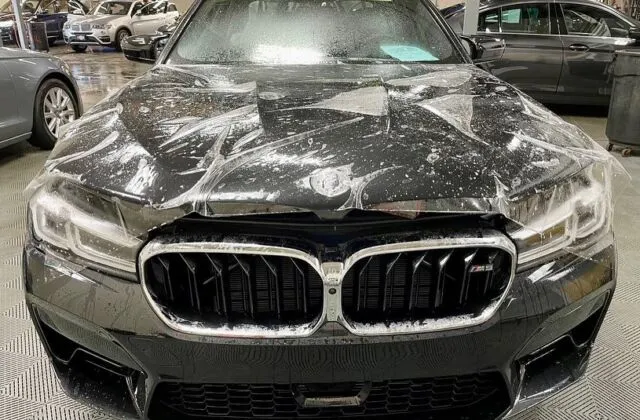
A reasonable way to check installation quality without technical expertise is to ask to see completed work in person, on a vehicle similar to yours, and to look closely at edges around door handles, mirrors, and body lines, the spots where poor prep and rushed trimming show up first. Photos on a website can be curated. Seeing an actual finished vehicle, or at minimum close-up photos of edge work rather than wide shots, gives you a more honest read.
It’s also fair to ask who will actually install the film and how much experience they have. At our shop, that’s Lou, our owner and an XPEL certified installer, with more than 18,000 installs over 20+ years. You can read more about our team, or visit the facility and see the process yourself.
What Winter on I-495 and Route 3 Adds to the Decision
New England winters put a specific kind of stress on exposed paint that doesn’t show up the same way in warmer climates. Road salt and sand treatments used through a Merrimack Valley winter accelerate the kind of surface pitting and chipping that PPF is designed to prevent, particularly on the leading edges of the hood and bumper. This is one of the more practical reasons vehicle owners in this area look into PPF proactively rather than after damage has already appeared. Once paint is chipped, film goes over existing damage rather than preventing it.
If you’re weighing whether to install film before winter or wait, the honest answer is that timing mostly affects how much existing damage you’re covering versus preventing. Film applied to already-chipped paint won’t reverse that damage; it protects the surface going forward. That’s a reasonable thing to factor into when you book, not just whether you book.
FAQ
Does PPF need to be reapplied after a New England winter?
No. Quality film is designed to handle seasonal road conditions for years, not months. What can happen after a hard winter is buildup of salt film or road grime that should be washed off promptly, since prolonged exposure to de-icing chemicals can affect the film’s clarity over time if left unwashed. Our PPF care instructions (PDF) cover how to wash film safely.
Can PPF be applied over a small existing chip to stop it from spreading?
Film can be applied over minor existing chips, but it won’t smooth or repair the chip itself. It seals it from further exposure. If the chip has already reached bare metal, that’s worth mentioning to the installer before application, since it may affect whether touch-up is recommended first.
Is partial front-end coverage enough for a daily highway commute?
It depends on which panels are included. Partial packages generally cover the areas most exposed on the highway (hood leading edge, front bumper, mirror caps), but if you’re commuting daily on stretches like I-495, ask specifically whether fender edges are included, since that’s a common gap between partial and full front-end packages.
Next Step
If you’re trying to decide between coverage levels or film tiers for your specific vehicle and driving pattern, that’s easier to sort out over the phone than by comparing quotes side by side. Call Paint Protection King in Tyngsboro to describe your vehicle, where you typically drive, and what you’re trying to prevent. That’s enough for a straight answer on which package actually fits, before any appointment is scheduled.
90 Progress Ave. Unit 1, Tyngsboro, MA 01879 · Get directions